
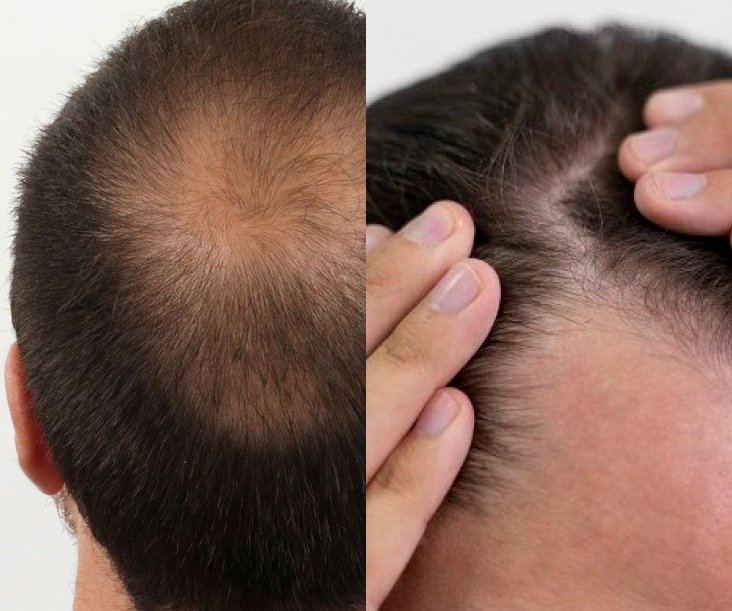
Hair loss is becoming a growing concern across the country, but it doesn’t affect everyone in the same way. Two of the most frequent patterns seen in clinical practice are receding hairlines and crown thinning. While both fall under pattern hair loss, they differ significantly in how they appear, progress, and are treated.
Understanding these differences is essential before considering a hair transplant in Kolkata or anywhere else, as each pattern requires a distinct surgical and long-term planning approach.
Understanding the difference between a receding hairline and crown thinning
Receding Hairline
A receding hairline typically begins at the temples or the frontal hairline and gradually moves backward. It is often one of the earliest visible signs of hair loss and follows a relatively predictable pattern.
Because the frontal hairline frames the face, even minor recession can significantly affect appearance. This makes receding hairline transplant procedures highly design-sensitive.
Crown Thinning
Crown thinning starts at the vertex (top-back) of the scalp and usually progresses more subtly. Since this area is less visible to the individual, crown thinning hair transplant cases are often addressed later, once noticeable density loss has already occurred.
The circular nature of crown hair loss also makes coverage and density more complex compared to frontal restoration.
What causes receding hairline vs crown hair loss? Hairline Recession
Receding hairlines are most commonly driven by genetics and sensitivity to dihydrotestosterone (DHT). The frontal scalp is particularly vulnerable to hormonal influence, which is why hairline recession often begins at a younger age.
Crown Thinning
Crown thinning is primarily driven by androgenetic alopecia with increased follicular sensitivity to DHT, often showing delayed clinical visibility due to the vertex’s hair geometry and whirl pattern. Age-related progression and genetic predisposition play a dominant role.
Difference in Progression
Hairline loss usually follows a structured and predictable pattern, while crown thinning tends to expand outward in a circular manner. This difference makes early diagnosis and planning critical, especially for crown-related hair loss.
How hair transplant planning differs for each pattern: For Receding Hairline Transplant:
- Focus is on design and symmetry, as the hairline frames the face ● Requires careful graft angle and direction for a natural look ● Usually needs fewer but strategically placed grafts
- Priority is long-term planning to prevent an “unnatural” hairline as loss progresses
A well-executed receding hairline transplant focuses more on aesthetics than volume.
For Crown Thinning Hair Transplant
- Planning focuses on density and coverage, not sharp design
- Requires more grafts due to the circular pattern of hair loss
- Hair swirl (whorl) direction must be recreated for natural growth
- Often combined with medical or regenerative treatments to maintain the surrounding hair
A crown thinning hair transplant prioritises visual fullness and scalp coverage. Crown transplantation is a secondary priority area in many patients and must be planned conservatively to preserve donor reserves for future frontal needs. Crown restoration often requires 1.5–2 times more grafts than frontal restoration due to its circular geometry and lower visual density efficiency.
Which hair transplant technique works best?
FUE (Follicular Unit Extraction)
FUE involves the extraction of individual follicular units and is commonly preferred in patients who:
- Desire short hairstyles
- Have limited graft requirements
- Wish to avoid a linear donor scar
- Require selective harvesting across a wider donor area
FUE allows flexibility in graft distribution but requires meticulous technique to prevent donor over-harvesting.
FUT (Follicular Unit Transplantation)
FUT involves harvesting a donor strip from the safe occipital zone and remains a gold-standard technique for:
- Patients requiring high graft numbers in a single session
- Those with stable donor density
- Long-term donor preservation strategies
When performed correctly, FUT provides excellent graft quality, high follicular yield, and predictable survival, with aesthetic outcomes comparable to FUE.
Technique Selection
The choice between FUE and FUT is determined by donor characteristics, total lifetime graft requirement, scalp laxity, hairstyle preferences, and long-term hair loss projection, rather than the recipient area alone (hairline or crown).
When performed correctly, both FUT and FUE demonstrate comparable graft survival rates, typically exceeding 95%.
Choosing the best hair transplant clinic in Kolkata
Choosing the best hair transplant clinic in Kolkata goes beyond comparing prices or before-and-after images. A credible clinic prioritises correct diagnosis, ethical graft planning, and long-term hair preservation.
At Esmer, hair transplant procedures are approached as a medical solution rather than a cosmetic shortcut. The focus is on understanding the pattern of hair loss before recommending any surgical intervention.
How Esmer approaches hair transplant planning
– Begins with a detailed scalp and hair loss evaluation to identify the pattern and stage of hair loss.
– Assesses donor area strength and long-term hair loss progression before planning graft placement
– Designs hairlines based on facial structure, age, and future loss risk rather than trends or reference photos
– Focuses on density distribution and natural hair direction, especially in crown thinning cases
– Combines surgical planning with medical treatments when needed to stabilise ongoing hair loss
– Prioritises natural-looking, sustainable results that age well over time
Hairfall has different patterns and symptoms, and they demand different strategies. Understanding these differences is the first step toward choosing the best hair transplant in Kolkata for your specific needs and achieving results that age well over time.